
The existential requirement for collective cyber defence: extending Article 5 to include a digital Article 5
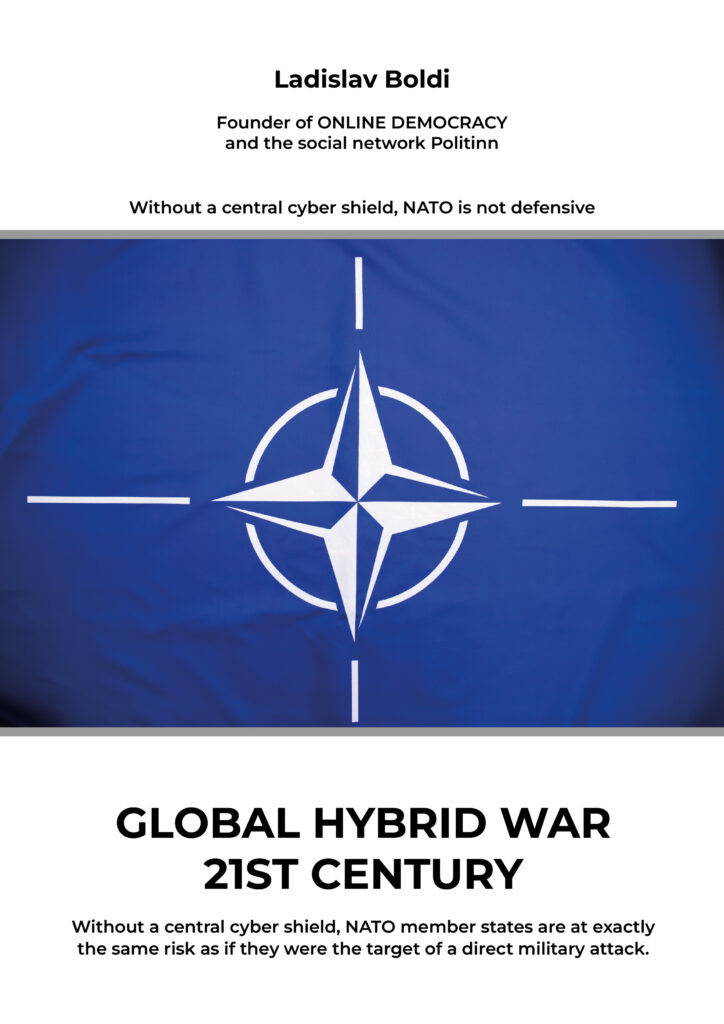
Without a central cyber shield, NATO member states are at exactly the same risk as if they were the target of a direct military attack.
NATO is currently not fully defensive. While it continues to make strategic investments in military infrastructure, its collective defence is being gradually weakened by the massive spread of disinformation, hatred, propaganda and manipulation of public opinion, especially on social media. These processes have given rise to information warfare, which has developed into the phenomenon known as disinfocracy – the most destructive hybrid regime of the 21st century, which systematically undermines citizens’ trust, destabilises democratic institutions and threatens the ability of member states to cooperate effectively in collective defence. As a result of these developments, some member states rightly question whether NATO can fully meet its commitments, including investment in defence capabilities and compliance with alliance agreements, as the key prerequisite for defence – trust in democracy and the stability of institutions – is at risk. The existential solution is therefore the introduction of the so-called digital Article 5, which would actively protect the alliance against the spread of disinformation, hatred, propaganda and manipulation of public opinion through a central cyber shield. This instrument will ensure comprehensive protection of trust, stability of democratic institutions and the real defense capability of member states and the entire NATO alliance in the digital age, making it an essential pillar of collective defense in the 21st century.
Atrocities are taking place in cyberspace, the extent of which neither citizens nor NATO member states are fully aware of. This digital horror includes not only the spread of disinformation, manipulation of public opinion, hatred, digital violence or information warfare, but also online masquerading – digital invasion of democratic countries, cyber-occupation of states – authoritarianism, restrictions on personal freedom and freedom of expression, censorship, radicalization on social networks – i.e. social terrorism, digital cancer, influence operations including intelligence activities, hybrid attacks on democracy, etc., which penetrate the physical world through mobile devices and existentially threaten democracy, subvert the state and critically weaken economic, technological development and national security. These destructive processes collectively represent a phenomenon known as “disinfocracy”.
NATO was historically conceived as a defense pact responding to conventional military threats, whose primary space was geographical borders, airspace and sea lanes. The key principle of collective defense enshrined in Article 5 of the North Atlantic Treaty was based on the assumption that aggression would take the form of a physical attack. In the 21st century, however, the focus of conflicts has fundamentally shifted to the digital domain and the cognitive sphere, where it is possible to weaken a state without firing a single shot.
For the first time in history, citizens live simultaneously in two parallel realities – the physical world and the digital world – that are structurally interconnected. If the sovereign protection of the state in cyberspace is not ensured, hybrid threats are directly transmitted to the physical space via social networks, mobile devices and network infrastructure, which can cause political destabilization, economic damage, disruption of critical infrastructure and security incidents with real impacts on the population.
The current Alliance cyber defence architecture is fragmented. Responsibility remains largely at the level of individual member states, whose technological sophistication, capabilities and investments in cybersecurity vary significantly. In an environment of rapid development of artificial intelligence, automated attacks and algorithmically driven information operations, such fragmentation is a strategic weakness. Digital infrastructure is deeply interconnected and transnational, while defence remains segmented and uneven. This mismatch creates structural vulnerabilities, where the weakening of one link can have a cascading impact on the security of the whole.
The construction of a central cyber shield therefore does not represent an institutional superstructure, but a necessary transformation of the security paradigm. The fate of all member states may depend on its functionality, because collective defence no longer takes place only at the borders of the territory, but in a continuous digital space, where public opinion is formed, critical infrastructure is managed and economic and military processes are coordinated. The protection of member states must be ensured not only in physical space, but also in cyberspace as an indivisible operational domain, because it is here that hybrid threats arise, which are subsequently transferred to political, economic and security realities and can fundamentally affect national and international stability.