
Dear citizens,
We are pleased to announce the launch of Politinn, a new social network and the first European platform that, thanks to its digital democratic infrastructure, innovative strategic features, and advanced security mechanisms, has enabled the creation of ONLINE DEMOCRACY—the world’s first political system in cyberspace.
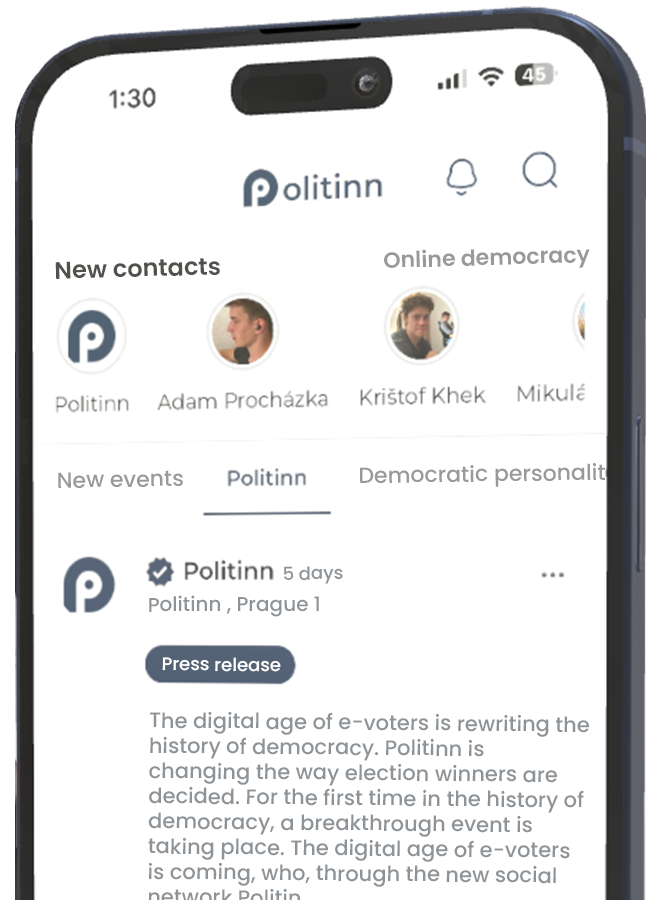
Download the ONLINE DEMOCRACY app to your phone, keep it handy, and whenever you encounter a problem in your personal, professional, or public life, share it with politicians and authorities via the Politinn social platform and, in your own interest, resolve it immediately and together.
The best way to engage in political and civic activity is to serve the public good for the benefit of society and the state.
The best thing you can do for yourself and your country is to share on the Politinn social network the activities you perform beyond your normal duties for the public good, including caring for your nation. Thanks to these merits, the public can nominate you for Democratic Personality of the Year as proof that you are indispensable and necessary for society and the state.
Never in the history of democracy has so much been done for its protection, technological progress, development, and future in the digital age as with the help of the Politinn social network. This platform allows you, as users of the internet and social networks, to download the ONLINE DEMOCRACY mobile app to your phone and use it to exercise your democratic rights and better protect yourself and your future.
Get involved too…
Citizens are building their state through the Politinn social network.
Online democracy is one of the most influential trends of the future that will change the world.
The old model of democracy is coming to an end because it was designed for a world that is now a thing of the past. Cyberspace, where all social and political events are moving, is becoming the main center of power and influence and, at the same time, a key sphere of control for modern states, including electoral processes.
Political power will depend on e-voters. Not only will they replace traditional voters, but they will no longer have to wait for the official election day to express their support for the politicians they trust most through "likes" on the Politinn social platform.
The traditional model of democracy has reached a point of systemic exhaustion. Moreover, it lacks the necessary technological infrastructure and security mechanisms, without which it is unable to meet the demands of modern society or adequately face the hybrid threats of the 21st century. For the first time in human history, citizens live in two worlds simultaneously—the physical and the digital—and this new dimension of reality requires entirely new approaches to the protection and management of society and the state.
In today's world, the security of citizens and the state cannot be ensured by traditional military force alone; it is absolutely essential to protect the digital statehood, sovereignty, and legitimacy of the state in cyberspace, where a key part of modern society, including politicians, now concentrates its power and influence.
The end of the traditional model of democracy and the transition to ONLINE DEMOCRACY is inevitable, as cyberspace is becoming not only the main center of power, but also a key tool of economic and media influence in every country. Politicians must fundamentally rethink how democracy is governed and protected, including security and digital legislation, to ensure the protection of citizens and the state in cyberspace. Digital statehood, sovereignty, national identity, and the legitimacy of the state in the online environment are taking on a new form and fundamental importance—principles on which the existence of every state depends today.
Politicians and journalists have a moral obligation in their daily activities to support democracy, its principles and values, and to contribute to national and international awareness. This responsibility applies not only to the real world, but also to cyberspace, where much of social and political communication is now taking place. If they neglect this duty, they undermine citizens' trust in democracy and its functioning. The best way to raise awareness is through a unique international initiative—the prestigious "Democratic Personality of the Year" award, which highlights examples of civic courage, the protection of democracy, and service to the public good. The development of democracy in cyberspace through the Politinn social network, the first European platform with a built-in digital democratic infrastructure, also plays a key role.
In the digital age, the traditional model of democracy is losing its legitimacy because it was created for the real world and is unable to respond adequately to the technological, security, political, and social changes of the 21st century. The established mechanisms of traditional democracy—power interests, corruption, protectionism, unprofessional handling of taxpayers' funds, poor political decisions that cause problems for citizens and the state, the spread of disinformation and hatred, including the manipulation of public opinion – deepen citizens' distrust of the state and its institutions with each passing day. The greater the distrust of the state and its institutions, the harder life is for citizens in the country.
In addition, current democracy is virtually dysfunctional in the digital age because it lacks the advanced integrated security systems and cyber protocols necessary to protect digital statehood, state legitimacy, digital infrastructure, and democratic order in cyberspace. It is from this space that the most significant hybrid threats of the 21st century are now penetrating mobile devices, social networks, and households, critically endangering the entire democratic world.
The ONLINE DEMOCRACY mobile application, linked to advanced artificial intelligence, is the most technologically advanced tool for building a modern, effective, and stable democratic system, the adoption of which is inevitable for all states—delayed implementation would critically jeopardize their ability to fully participate in future political and global structures.
Artificial intelligence in the ONLINE DEMOCRACY application represents the technological pillar of the first political system in cyberspace, which streamlines e-communication between citizens and the state in the evaluation and approval of political proposals, optimizes the development of the system, supports the innovative creation of digital political programs and strategic planning, and contributes significantly to the preparation of the state budget with all parametric changes. At the same time, it ensures control of voting mechanisms and security protocols in e-elections, minimizes the need for traditional political structures, and protects digital statehood and the legitimacy of the state in the cyber future.
For more than 5 billion Internet and social network users, there can only be one ONLINE DEMOCRACY in the digital age. It does not matter whether its form is parliamentary, presidential, semi-presidential, direct, or other—new rules apply in cyberspace. Its constitutional pillar is digital statehood and the legitimacy of the state, where citizens, in their role as e-voters, fully exercise their voting rights.
The introduction of the principles of digital statehood through the application of ONLINE DEMOCRACY, supported by advanced artificial intelligence, represents an evolutionary step towards secure, effective, and stable state administration, corresponding to the technological, security, and social conditions of the 21st century. This approach makes it possible to restore citizens' trust in democracy and constitutional institutions, preserve the legitimacy, sovereignty, and national identity of the state in cyberspace, and strengthen its resilience to hybrid threats, destabilizing influences, and cyberattacks. ONLINE DEMOCRACY combines technological innovation and artificial intelligence with new principles of state governance, transfers the administration of public affairs to the digital space, and promotes effective cooperation between citizens, politicians, and the state administration in solving problems, thereby ensuring the continuity, legitimacy, and long-term stability of the democratic order.
Definition: Digital statehood protection is a set of measures to ensure the protection of the state, its legitimacy, and sovereignty in cyberspace.
Hostile governments target the most vulnerable component of state stability—their cyber armies infiltrate social networks and mobile devices and attack digital statehood, i.e., the sovereignty, institutional authority, territorial identity, and democratic legitimacy of the state in the online world. In doing so, they critically undermine citizens' trust in their own state.
Digital statehood is a modern pillar of national sovereignty and state legitimacy in cyberspace. It is based on protecting citizens' trust in the state, its institutions, and the democratic process in an environment influenced by new technologies, social networks, and artificial intelligence. Without the protection of digital statehood, there is a risk of the gradual disintegration of families, society, and the state as a result of hybrid threats penetrating from cyberspace into all mobile devices, social networks, and households.
The loss of citizens' trust in the state and its institutions is one of the most feared threats of the 21st century. Without trust, citizens find it increasingly difficult to live in their own country, as their sense of security, justice, and belonging to the state disappears. Distrust of political representation devalues its work, threatens the legitimacy of political parties and movements, and complicates the ability to effectively enforce public policies.
The loss of citizens' trust in the state and its institutions is gradually turning into hatred in society and distorting the security, social, economic, environmental, and legal stability of the state. It causes security and social tensions, deepens citizens' frustration, which is reflected in the escalation of conflicts, the rise of extremist attitudes, and the radicalization of citizens on social networks. It slows down economic development, dampens prosperity and progress, and ultimately causes the breakdown of families and society and the collapse of the state.
The scale of social distrust in the state and its institutions reveals the state's insufficient defense against hybrid threats penetrating from cyberspace into mobile devices, social networks, and households:
Digital statehood is most often threatened by fake accounts, including those from abroad or purchased on black markets. These hybrid accounts increase unrealistic numbers of followers and friends, distort public opinion, threaten national security, online voting, nominations for Democratic Personality of the Year, and citizens' trust in democracy and their own state.
To ensure the protection of the state, its legitimacy, and sovereignty in cyberspace, it is necessary to establish a specialized National Security Center for the Protection of Democracy (NBCOD) – without this pillar of national security, the protection of digital statehood would be critically threatened. The center would replace outdated state authorities focused exclusively on protecting physical space, merge national cyber and security agencies, and partially cooperate with intelligence services. It would ensure coordination with international organizations, such as NATO, and other strategic partners.
The main mission of the NBCOD will be to protect and restore trust in democracy, the state, and its institutions, and to ensure that hybrid threats penetrating from cyberspace into mobile devices, social networks, and households do not cause the disruption of families, society, and state structures. This task goes beyond the scope of activities and powers of constitutional officials, individual state authorities, security forces, police, intelligence services, and other specialized agencies. It requires the creation and systematic management of an integrated "Democratic Security Strategy" concept, which presupposes super-competence and extraordinary professional capacity in the areas of research, analytical activities, risk operations, infiltration into conflict environments, data collection, securing and verification, information and personnel screening, as well as the development of methods for preventing disinformation and manipulation through artificial intelligence and other advanced digital technologies.
In the digital age, it is essential for the state to have an integrated and sophisticated infrastructure for protecting its digital statehood, capable of coordinating the prevention, detection, and neutralization of threats, analyzing the digital environment, and protecting citizens from manipulation and disinformation. Only strategic digital statehood security can maintain stable and legitimate state institutions, preserve citizens' trust, ensure a high quality of life, effective public services, and long-term prosperity for society in the 21st century.
"Democracy has its application"
ONLINE DEMOCRACY – the first political system in cyberspace Online democracy represents a new format of democratic political system in the digital age, in which the exercise of democratic power, political participation, and decision-making processes are shifting to digital and cyberspace. This model is not emerging as a supplement to traditional democracy, but as its natural evolution in response to technological developments, societal changes, and changes in the way citizens communicate, organize, and exercise their political will. One of the key pillars of this digital democratic infrastructure is e-voting, which is fundamentally transforming the electoral process and the relationship between citizens and political representatives.
Through the Politinn platform, traditional voters become e-voters who are not limited by fixed election dates and can express their political will online through the ONLINE DEMOCRACY mobile application. At the same time, candidates become e-candidates who can conduct their election campaigns on the Politinn social platform without financial barriers and reach e-voters across the country in a continuous digital space. This creates a new cyber model of the electoral process that connects the state's digital infrastructure with an intelligent system of targeted online voting and enhances the transparency, accessibility, and equality of political competition.
The ONLINE DEMOCRACY application allows citizens to participate continuously and directly in democratic decision-making. Citizens can express their opinions in real time, respond to current political developments, propose solutions to social problems, and participate in the management of public affairs. This model overcomes the limitations of traditional democracy based on long election cycles and strengthens the ongoing accountability of political power to citizens. At the same time, it protects and develops key democratic values, promotes e-communication, transparent public reporting, and the building of digital statehood, national identity, sovereignty, and the legitimacy of the state in cyberspace. Direct citizen participation strengthens trust, social cohesion, and state stability, increases the efficiency of public administration, enables the early identification of hybrid threats, and strengthens the legitimacy of the democratic system in both real and cyber space.
Online democracy must be built on five key pillars:
Politinn is a social network and the first European platform of the new generation originating in the Czech Republic. It is the only one in the world to integrate a digital democratic infrastructure that allows citizens to actively enter the political system of ONLINE DEMOCRACY – there is no other way to enter this system.
The mission of the Politinn platform is to help people solve everyday problems while creating space for them to promote their own priorities, needs, interests, and visions. Citizens can actively exercise these opportunities in political and public life. Politinn connects technology with politics and allows users to independently moderate their political influence through features such as online expressions of confidence or voter support, and other optional tools that fundamentally transform electoral processes and political development around the world.
Virtual offices on the Politinn social network are a modern and technologically advanced tool for e-communication between citizens, public administration institutions, and private sector entities. E-communication is a fundamental pillar of online democracy and responds to the rapidly growing need for accessible, trustworthy, and secure dialogue between citizens and the state.
Virtual offices can be operated by politicians, state and local government bodies, the Czech Police, fire departments, healthcare facilities, schools, social services, employment offices, courts, cultural and scientific institutions, and other entities performing public services. They can also be used by private companies, banks, insurance companies, telecommunications and energy companies, media houses, professional chambers, and other organizations communicating with the public, clients, or employees.
Citizens can visit virtual offices in the form of live broadcasts, engage in e-communication, ask questions, solve problems, and deal with their affairs. Any issues that cannot be resolved during the day can be followed up with a personal visit to the virtual office online.
The fundamental principle is compliance with security criteria. Virtual offices can only be set up on the Politinn platform, where the identity of all users is verified. Setting up offices on other social networks poses a high security risk—threats to life and health, misuse of personal data, fraud, extortion, digital violence, and other criminal activity caused by the presence of anonymous or fake accounts and avatars generated by artificial intelligence that pretend to be real people.
Virtual offices significantly save time and money for citizens and the state. They increase the availability of health, social, and public services, reduce the administrative burden, and allow matters to be dealt with from anywhere. At the same time, they significantly strengthen public confidence and thus the immune system of democracy.
The cornerstone of digital democratic infrastructure is its immune system, on which not only the development and stability of democracy depend, but also citizens' trust in its functioning. Without this system, the full, secure, and transparent functioning of democratic processes in the digital age would not be possible.
The system ensures the secure, fair, and open participation of citizens and politicians in e-communication through the Politinn social platform. Its pillars are e-elections, e-voters, and e-candidates, who can actively participate at all levels of elections through digital identity. The infrastructure also supports equal access to political competition, for example in the form of free pre-election campaigns for candidates and political entities without financial backing.
The digital democratic infrastructure is designed to be compatible with the emerging digital legal framework based on the principles of a digital constitution, digital laws, and a digital bill of rights and freedoms, which will protect civil rights and freedoms in the online environment in the future. The system also includes integrated security mechanisms, such as the National Security Center for the Protection of Democracy, which protects trust in democracy from hybrid threats, increased security and social tensions in society, and the spread of disinformation, hatred, and manipulation—mechanisms that penetrate directly into the lives of citizens through social networks, mobile devices, and cyberspace.
At the international level, this infrastructure supports cooperation between democratic states, knowledge sharing, and the strengthening of democratic values. An integral part of this is also international education about democracy, represented by the prestigious "Democratic Personality of the Year" award, which highlights the contribution of heroes of democracy who sacrifice themselves for the benefit of democracy and act for the public good in their personal and professional lives.
The immune system of democracy is a digital organism within which citizens share their everyday problems and seek meaningful solutions via the Politinn social network. Just as the biological immune system protects the body from threats, the democratic immune system protects society and the state from hybrid threats. This system ensures the constant circulation of information between citizens, politicians, and institutions, thereby strengthening the resilience, transparency, and ability of democracy to respond to new challenges.
Citizens here function as cells of a democratic organism—through their suggestions, opinions, ideas, visions, and evaluations of politics, they activate mechanisms that keep democracy healthy, functional, and credible. The Politinn social network acts as a digital nervous system in this process, connecting all components of society in real time. It enables the timely identification of problems, the collective formulation of proposals, and immediate feedback, thereby preventing the accumulation of social tension and promoting an active and conscious civic culture. Without the immune system of democracy, a democratic state could not exist in the digital age.
An integral part of the immune system of democracy is national education about democracy, in which the heroes of democracy play a key role – ordinary citizens who have received the prestigious "Democratic Personality of the Year" award for their extraordinary work achievements and for acting in the interests of democracy and the public good. In this era of hybrid wars and international conflicts, these heroes are pillars of strength, setting an example for their nations and contributing to the lasting restoration of trust, stability, and justice.
However, the immune system of democracy cannot be protected by any army, tanks, artillery, missiles, drones, or fighter jets. Current hybrid threats—social terrorism, i.e., the radicalization of citizens on social networks, digital violence, the spread of disinformation and hatred—are penetrating mobile devices, social networks, and cyberspace. The protection of this system must be ensured by a modern National Security Center for the Protection of Democracy, which, through the prevention, detection, and neutralization of threats, strengthens the cyber resilience of the state and society, restores citizens' trust, and guarantees the long-term stability and security of the democratic order.
The state must be protected not only in traditional physical space, but also in cyberspace, which in the 21st century has become a new strategic environment with a direct impact on the security, stability, and very existence of modern democratic states. Ensuring territorial integrity and protecting airspace are no longer sufficient on their own, because key attacks against the state today are not carried out with tanks or missiles, but through digital technologies, information flows, and psychological operations conducted in the online environment.
Today, cyberspace effectively creates virtual state borders – an intangible but essential space that has a direct impact on the functioning of state institutions, democratic processes, social cohesion, and the security of citizens. However, this space is not protected, is not clearly defined in the legal system, and is not entrusted to any specialized state authority with the appropriate powers. The state does not yet exercise its sovereignty here, which creates a dangerous security vacuum that is deliberately exploited by foreign actors.
It is precisely this unprotected space that is being exploited by hybrid threats carried out by the cyber armies of foreign states. These state-controlled digital structures conduct coordinated and long-term operations aimed at destabilizing democratic systems without the use of conventional military force. Through disinformation, hate speech, propaganda, and manipulation of public opinion, they penetrate directly into citizens' mobile phones, social networks, and everyday lives, gradually undermining their perception of reality, their trust in the state, its institutions, and the democratic system itself.
Virtual state borders must therefore be taken as seriously as land, air, or sea borders. Their violation by the cyber armies of foreign states has comparable (and in some cases even more serious) consequences than the violation of physical territory. While classic military aggression is immediately recognizable, hybrid attacks are covert, long-term, and systematic, often without society realizing that it has become the target of a controlled operation by a foreign power.
Protecting a state's virtual borders includes protecting its digital statehood, national identity, digital sovereignty, information integrity, democratic processes, and the digital rights of its citizens. It is about protecting the state's ability to make autonomous decisions, manage its institutions, and defend itself against targeted actions by foreign cyber armies whose goal is to undermine social cohesion in the long term, weaken the legitimacy of state power, and gradually take over political influence without direct military confrontation.
For this reason, it is necessary to establish a National Security Center for the Protection of Democracy (NBCOD) as a new independent pillar of national security. None of the existing security agencies or intelligence services were created to defend the state against hybrid operations conducted by cyber armies of foreign states in the digital and information space. Their mandate and structure are based on the era of physical space protection and are unable to comprehensively respond to the current form of digital aggression.
The NBCOD must be established so that the state has a specialized institution capable of protecting the virtual borders of the state against hybrid operations by cyber armies and restoring citizens' trust in democracy and state institutions. Without a National Security Center for the Protection of Democracy, every state in the digital age will remain structurally unprotected and exposed to the actions of foreign cyber armies.
In the digital age, protecting the virtual borders of the state from hybrid threats, including operations by cyber armies of foreign states, is becoming a top priority for ensuring the protection of democracy, digital statehood, sovereignty, and the stability of society. Without an institutionally anchored defense of cyberspace, democratic states will not be able to defend themselves in the long term against hybrid warfare waged against them quietly, systematically, and without a single shot being fired.
The hybrid political program represents a modern approach to managing society, the state, and public administration, integrating the physical and digital worlds and using modern technologies, in particular the Politinn social network with its integrated digital democratic infrastructure, to engage citizens in political decision-making. Unlike traditional political programs, which were constructed in isolation, without public involvement, the hybrid program allows citizens, politicians, and public administration to collaborate in real time, identify problems, formulate needs and priorities, and directly influence political decisions. A key element of the hybrid political program are virtual offices, which create an institutional framework for citizen participation and ensure that cyberspace becomes an integral part of the democratic process.
Thanks to the new hybrid political program and the innovative model of the electoral system on the Politinn social network, a direct digital link between politicians and e-voters is being created for the first time in the modern history of democracy. Registered politicians and e-candidates gain the ability to link directly to e-voters on their profiles, who can publicly express their voter support online. This technological trend is shaping a new generation of voters and candidates for the cyber future of democracy. Politicians who fail to adapt in time risk an exodus and loss of voters whose political support is shifting to cyberspace.
For the first time in modern human history, citizens are living in two worlds simultaneously—the physical and the digital—and this new dimension of reality is fundamentally changing the conditions under which the state, democracy, and society function. The future of democracy is being decided today in cyberspace, where, as in the physical world, it is necessary to ensure the security of citizens and states against hybrid threats to which traditional political programs are no longer able to respond adequately because they are technologically outdated.
A hybrid political program is a key pillar of the 21st century, without which it is not possible to realistically ensure the security of citizens and the state against hybrid threats, sustainably govern the state, or build long-term prosperity and technological progress in the context of the cyber future.
The fact that traditional political programs do not reflect the need to protect the population, the state, and democracy in cyberspace from hybrid attacks and threats clearly confirms their technological and conceptual backwardness. Yet protecting cyberspace in the 21st century is just as necessary as protecting airspace and territorial integrity in the physical world. Politicians who ignore this reality fail to meet the basic criteria of modern security policy and gamble not only with the security of citizens and the state, but also with the future of the country.
If politicians—individuals, political parties, or movements—fail to present voters with a new hybrid political program, they risk not only losing voter support, but also failing to protect the security of citizens and the state, as without a hybrid political program they are unable to effectively counter hybrid threats.
If politicians want to protect citizens and retain their voters, they should inform them as soon as possible about the preparation and implementation of a new hybrid political program for the 21st century. Unlike outdated programs, this program meets all security and technological parameters and ensures the protection of citizens and the state against hybrid threats.
The hybrid political program emphasizes the integration of modern technologies and social networks with digital democratic infrastructure, such as the Politinn platform, into public administration and political decision-making. This model allows citizens, politicians, and the state administration to collaborate effectively, share needs, provide feedback, and express voter support online.
Pillars of the hybrid political program for the 21st century.
The goal of any hybrid political program is to effectively address social issues through modern technologies, particularly the Politinn social network, the only platform in the world with a fully integrated digital democratic infrastructure.
Cyberspace can no longer be perceived as a supplementary communication channel separate from political decision-making; on the contrary, it is becoming an integral part of it, shaping opinions, priorities, expectations, and political legitimacy. For this reason, all areas of public policy must be incorporated into a hybrid political program that fully reflects the interconnection between the physical and virtual worlds.
An integral part of the New Hybrid Political Program are virtual offices on the Politinn social network. These offices create an institutional framework in which citizens, politicians, and public administration jointly identify problems, formulate their needs, interests, and visions, and actively participate in solving them. Virtual offices thus enable the transformation of cyberspace into a fully-fledged part of political decision-making and provide an environment that corresponds to the reality of digital society, making them an absolutely key tool of the hybrid political program.
Politická moc bude závislá na e-voličích: O tom, který politik vyhraje volby, již nerozhodují televizní diváci, čtenáři, ani uživatelé či přátelé na tradičních sociálních sítích, ale pouze e-voliči na platformě Politinn, kteří vyjadřují svou online voličskou podporu těm, jimž nejvíce důvěřují, a svými lajky jim svěřují vládu do rukou.
Jejich činnost posiluje transparentnost rozhodovacích procesů, podporuje rovnost v přístupu k politickému dění a přispívá k obnově morálních hodnot demokracie. Tento inovativní model volebního procesu zvyšuje bezpečnostní, sociální, ekonomickou i právní stabilitu státu, zlepšuje kvalitu života občanů a umožňuje flexibilní adaptaci státní politiky na aktuální výzvy.

The greatest threat destroying and disrupting the physical world today is the fact that cyberspace, home to a digital civilization of more than five billion Internet and social media users, lacks the three fundamental international pillars for protecting democracy, citizens, and states. As a result, hybrid attacks are penetrating phones and homes, causing security and social conflicts in the real world.
The three fundamental international security pillars for protecting democracy, citizens, and states in the world are:
The internet and social networks connect more than five billion users without any borders, so the laws of individual states or regions, such as the EU, are virtually powerless here.
Without international security, there is a risk of hybrid attacks on citizens and states and chaos; without a shared value compass, misinformation, manipulation, and hatred spread; and without global law, there is no accountability or protection of democracy, fundamental rights and freedoms, digital statehood, sovereignty, national and digital identity, and the legitimacy of the state in cyberspace. This vacuum of stability and ethics in digital civilization immediately translates into the real world and threatens security, democracy, and civilization itself.
Failure to ensure the protection of the state in cyberspace is an alarming political failure and a serious offense, comparable to failing to ensure the protection of the state's airspace and territorial integrity. Without effective protection of the state in cyberspace, its defense capabilities, security, social, economic, environmental, and legal stability are critically weakened, as are its long-term development, prosperity, technological progress, and the very future of the country.
Cyberspace has become a global environment without borders, from which hybrid threats now penetrate the real world and systematically disrupt the functioning of state institutions, critical infrastructure, and the safety of citizens. The current world cannot do without a global digital organization, because cyberspace cannot be effectively managed or protected in isolation at the level of individual states. The absence of common rules, coordinated defense, and global oversight will lead to massive hybrid attacks, weakening the security of states, disrupting critical infrastructure, loss of sovereignty, destabilization of society, and erosion of digital statehood.
The digitization of the state is unthinkable and directly contradicts the fundamental security, legal, and organizational principles of a modern democratic state unless it is systematically built on the following pillars:
The digitization of the state is unsustainable in the long term and directly contradicts the fundamental security, legal, and organizational principles of a modern democratic state if it is not built on secure and trustworthy e-communication between citizens and the state. This communication hub forms the very basis of digital statehood, as it allows citizens to communicate directly with politicians, authorities, state administration institutions, and other public bodies via virtual offices on the Politin social platform, to resolve personal, professional, and public issues, and to prevent lengthy or unnecessary disputes and administrative complications.
Without secure e-communication, the handling of administrative and official agendas through information systems (eGovernment) becomes fundamentally ineffective. The digitization of the state is not just a matter of technical processing of administrative tasks; in addition to digitized bureaucracy, it must enable citizens to communicate securely with politicians, authorities, institutions, and state administration via virtual offices on the Politin social platform, resolve personal, professional, and public issues, and respond effectively to problems in society.
The greatest threat to the digitization of the state is poor communication between citizens and the state, as it exacerbates problems in society, burdens public administration, leads to excessive bureaucracy, repeated handling of the same issues, and inefficient use of administrative resources.
Digital bureaucracy alone can never fulfill the fundamental principles of state digitization if it does not include secure and trustworthy e-communication between citizens and the state as an integral part.
Online expression of trust is a fundamental function of the immune system of ONLINE DEMOCRACY. The strength of a state's protection, its digital statehood, national sovereignty, and legitimacy in cyberspace depends on the extent to which citizens trust the political system, constitutional bodies, public administration, security forces, courts, the military, business entities, and society as a whole. Without this trust, it is impossible to develop democratic institutions, ensure the stability of public processes, or build a viable state capable of resisting hybrid threats, protecting national identity, and adapting to the technological and social challenges of the 21st century.
The Politinn platform makes it possible to put this principle into practice. It provides citizens with tools to actively support individual bodies and institutions, participate in shaping public policy, submit proposals, monitor updates, and express their trust online, thereby linking their participation to the protection of digital statehood and strengthening the legitimacy of the state. As a result, democracy becomes a living system of continuous interaction between people, the state, and institutions. The mechanism integrates innovation, digital technologies, and the principles of good governance, creating space for transparent, accountable, and fair decision-making while strengthening the continuity, stability, and long-term prospects of society as a whole.
Online expression of trust is a basic function of the immune system of ONLINE DEMOCRACY. The strength of the protection of the state, its digital statehood, national sovereignty and legitimacy in cyberspace depends on the extent to which citizens trust the political system, constitutional institutions, public administration, security forces, courts, military, business and society as a whole. Without this trust, it is impossible to develop democratic institutions, ensure the stability of public processes or build a viable state that is able to withstand hybrid threats, protect national identity and adapt to the technological and societal challenges of the 21st century.
The Politinn platform makes it possible to put this principle into practice. It provides citizens with tools to actively support individual bodies and institutions, participate in shaping public politics, submit proposals, follow updates, and express online trust, thereby linking their participation with the protection of digital statehood and strengthening the legitimacy of the state. This makes democracy a living system of continuous interaction between people, state and institutions. The mechanism integrates innovation, digital technologies and principles of good governance, creating space for transparent, accountable and fair decision-making, while strengthening continuity, stability and the long-term perspective of society as a whole.
The Politinn social network is a unique platform that allows citizens to vote securely and transparently online for political representatives and candidates using verified digital identities. This principle means that voters do not have to wait for traditional election dates, which represents a complete revolution in the history of politics. Online voting is a key mechanism of ONLINE DEMOCRACY, enabling continuous and meaningful participation of e-voters in the public political sphere.
The strength of a state's protection, its digital statehood, national sovereignty, and legitimacy in cyberspace is directly derived from the online voting of politicians and candidates. The extent to which citizens support political representatives through e-voting determines the state's resilience to hybrid threats, its ability to protect national identity, and the stability of the democratic order.
The Politinn platform enables the implementation of this principle: e-voters can actively support politicians and candidates, follow updates to their programs, submit proposals, and express their support in real time. The system integrates technological innovations, security standards, and principles of good governance, creating space for transparent, accountable, and fair decision-making and strengthening the continuity, stability, and long-term perspective of society.
Online voting for politicians and candidates is not merely a digitization of traditional elections, but represents a transformative mechanism of modern democracy that ensures the protection of the legitimacy, sovereignty, and digital statehood of the state and enables citizens to become true co-creators of the democratic process.
The heroes of democracy are citizens who, beyond their daily duties, act for the public good for the benefit of society and the state, and whose actions prove that they are indispensable to the nation.
One of the most significant events of the present day is the annual celebration of International Democracy Day on September 15, which aims to raise awareness of the importance of democracy, trust, and civic responsibility. The social platform Politinn plays a key role in this process as the sole organizer of the prestigious "Democratic Personality of the Year" award, which is given directly by citizens—users of the platform.
In today's extremely complex times, it is increasingly difficult to discern what or who truly serves society and the state, and what—or who—is acting against the national interest. That is why the prestigious Democratic Personality of the Year award is an integral part of not only national but also international education, in which the nominations themselves represent an extremely important act, as they convincingly show who, beyond their daily duties, acts for the public good for the benefit of society and the state, including caring for their nation. With full respect for all citizens, the nominations clearly define people's social status according to their demonstrable achievements in their personal, professional, and public lives and their contributions to the public good. They highlight those who voluntarily go beyond their normal duties, bring concrete benefits to society and the state, and through their courage, responsibility, and service become true heroes of democracy, an inspiration to all citizens, and a living symbol of the values on which the state is based.
The prestigious "Democratic Personality of the Year" award awakens in people a sense of national pride, trust in democratic principles and values, and love for their homeland, which can truly be fulfilled by serving the public good for the benefit of society and the state.
ONLINE DEMOKRACIE představuje největší civilizační událost v dějinách lidstva – první politický systém na světě, který plně existuje v kyberprostoru. Tento historický průlom umožňuje, aby se poprvé aktivně zapojila celá digitální civilizace – více než pět miliard uživatelů internetu a sociálních sítí – a zároveň poskytuje bezprecedentní možnost chránit digitální státnost, národní suverenitu a legitimitu státu prostřednictvím digitální demokratické infrastruktury vybudované sociální sítí Politinn.
Díky této historické výhodě si mohou občané na celém světě stáhnout mobilní aplikaci ONLINE DEMOKRACIE do svých telefonů a stát se plnohodnotnými účastníky demokratického procesu. Mohou tak přímo ovlivňovat veřejný, politický i společenský život v reálném čase, bez časových, prostorových či finančních omezení.
ONLINE DEMOKRACIE přetváří tradiční politické struktury a nahrazuje je transparentní, inkluzivní a technologicky bezpečnou formou vládnutí. Posiluje důvěru, právní jistotu, sociální soudržnost i ekonomický rozvoj, čímž vytváří stabilní rámec pro udržitelnou budoucnost moderních států. Tento koncept má podporu Evropské unie i Spojených států amerických, které dlouhodobě prosazují digitální participaci, otevřené vládnutí a ochranu demokracie v online prostoru.
ONLINE DEMOKRACIE není pouhým nástrojem správy státní politiky – představuje globální revoluci politického myšlení, propojuje technologickou civilizaci s demokratickými principy a umožňuje občanům všech zemí společně vytvářet, rozvíjet a chránit demokracii v digitálním věku.
Veřejné zpravodajství představuje základní pilíř ONLINE DEMOKRACIE a nejefektivnější nástroj ochrany digitální státnosti, důvěry občanů ve stát a jeho instituce. Prostřednictvím sociální sítě Politinn, vybavené plně integrovanou digitální demokratickou infrastrukturou, získávají občané komplexní, ověřené a průběžně aktualizované informace o činnosti politiků, veřejné správy, orgánů státní moci, místní samosprávy, nemocnic, škol, policie, armády a dalších veřejných institucí.
Tento systém umožňuje občanům sledovat aktuální rozhodnutí, investice, veřejné zakázky i další aktivity, které ovlivňují každodenní život, a poskytuje jedinečný nástroj pro posilování transparentnosti a odpovědnosti veřejných činitelů. Veřejné zpravodajství tak zajišťuje, že každý občan může mít přehled o činnosti státního aparátu, hodnotit ji a prostřednictvím digitálních nástrojů aktivně podporovat ochranu veřejného zájmu.
Nejde jen o informovanost – veřejné zpravodajství je historickým průlomem v řízení státu, protože propojuje etiku, odpovědnost a transparentnost s aktivní participací e-voličů. Každý občan se stává součástí imunitního systému demokracie, přispívá k ochraně digitální státnosti, posiluje důvěru v instituce a upevňuje stabilitu státu.
Veřejné zpravodajství proto představuje nejvyšší formu demokratické angažovanosti: poskytuje občanům moc, jak chránit svůj stát, podporovat efektivní hospodaření a transparentní správu, a tím zajišťuje dlouhodobou životaschopnost a odolnost demokratického řádu v digitálním věku.
ONLINE DEMOCRACY must be legally enshrined in the constitution in order to protect digital statehood, sovereignty, and legitimacy in cyberspace. The state is obliged to define and implement mechanisms of digital statehood that enable citizens to exercise their democratic rights safely, freely, and transparently in the digital environment. Constitutional enshrinement also ensures that state institutions – the president, parliament, senate, government, judicial system, security forces, schools, hospitals, and public media – maintain their credibility, authority, and continuity.
Such a framework is necessary to prevent and protect against hybrid threats, cyberattacks, and disinformation campaigns that undermine citizens' trust, the stability of state power, and the security of society.
To effectively protect digital statehood, it is necessary to adopt digital legislation that clearly defines the powers of state authorities, the rights and obligations of citizens, the rules of electronic voting, the registration of e-voters and e-candidates, the transparent presentation of political proposals, and the secure participation of citizens in decision-making processes. This legislation must also protect the state and its citizens from the spread of disinformation, manipulation, and abuse of cyberspace against democratic institutions.
ONLINE DEMOCRACY is the first digital political system that connects citizens, institutions, and modern technologies into a unified and secure framework for state governance. The legal anchoring of this system ensures that every citizen can actively participate in decision-making on public issues, submit candidacies, initiate referendums, and monitor the activities of state institutions.
ONLINE DEMOCRACY is thus an essential part of a modern democratic state and its constitution. Its goal is to ensure that power truly comes from the people, that state institutions are transparent, accountable, and trustworthy, and that every citizen can exercise their democratic rights safely and responsibly, even in the digital space.
Digital statehood and state legitimacy thus become the fundamental pillars of stability, resilience, and trust in modern 21st-century democracy.
The Student Parliament represents the most natural and effective entry point for students into online democracy and, at the same time, the most powerful tool for national and international education about democracy for its future. For the first time in history, students have the opportunity to have their own prime minister, their own government, and their own parliament, making the democratic process an authentic experience for them, rather than just a theoretical explanation. This model sets a standard that can also inspire European Union member states, as it systematically prepares a new generation for responsible public administration in the digital age.
It is a nationwide digital platform that brings together existing local and regional student parliaments into a single national institute and operates on the Politinn social network. Any citizen or minor aged 15 or older can run for office, regardless of whether they are 18 or 19 years old. Through this social network, candidates can run for specific positions—prime minister, ministers, and members of parliament—and at the same time vote electronically as e-voters. Candidacy is based on individual responsibility for a specific position, which strengthens personal leadership, transparency, and the direct link between the program and the performance of the mandate.
The entire system simulates the functioning of real institutions—a legislative body representing individual regions, a government led by a prime minister and individual ministers—and provides students with a unique opportunity to learn about the legislative, executive, and decision-making processes of the state. Students elect their representatives in individual regions, thus preserving the principle of territorial representation in a universally applicable model for different states. The system is designed as a transferable platform that can be used in any country. It prepares them for active participation in both online and physical spaces, develops critical thinking, civic responsibility, and the ability to protect democracy and the state not only in the physical world, but especially in cyberspace.
The Student Parliament is part of the educational framework and allows students to experience the functioning of democracy in the conditions of today's digital reality. Through direct participation in the electoral process, the election of representatives, and the formation of a government, students learn the principles of protecting democracy, especially in an environment where it is exposed to hybrid threats and information manipulation. They acquire the knowledge and skills necessary to protect infrastructure, digital statehood, national identity, sovereignty, and the legitimacy of the democratic system.
The Politinn social network combines theoretical education with practical experience: students organize campaigns, submit proposals, lead public discussions, and learn to communicate safely in an online environment. The student parliament thus represents a unique democratic laboratory where democracy is taught, systematically developed, and actively protected, providing students with comprehensive preparation for responsible life in a modern digital society.